Artificial Intelligence: Types, Advantages, Disadvantages and Future Scope
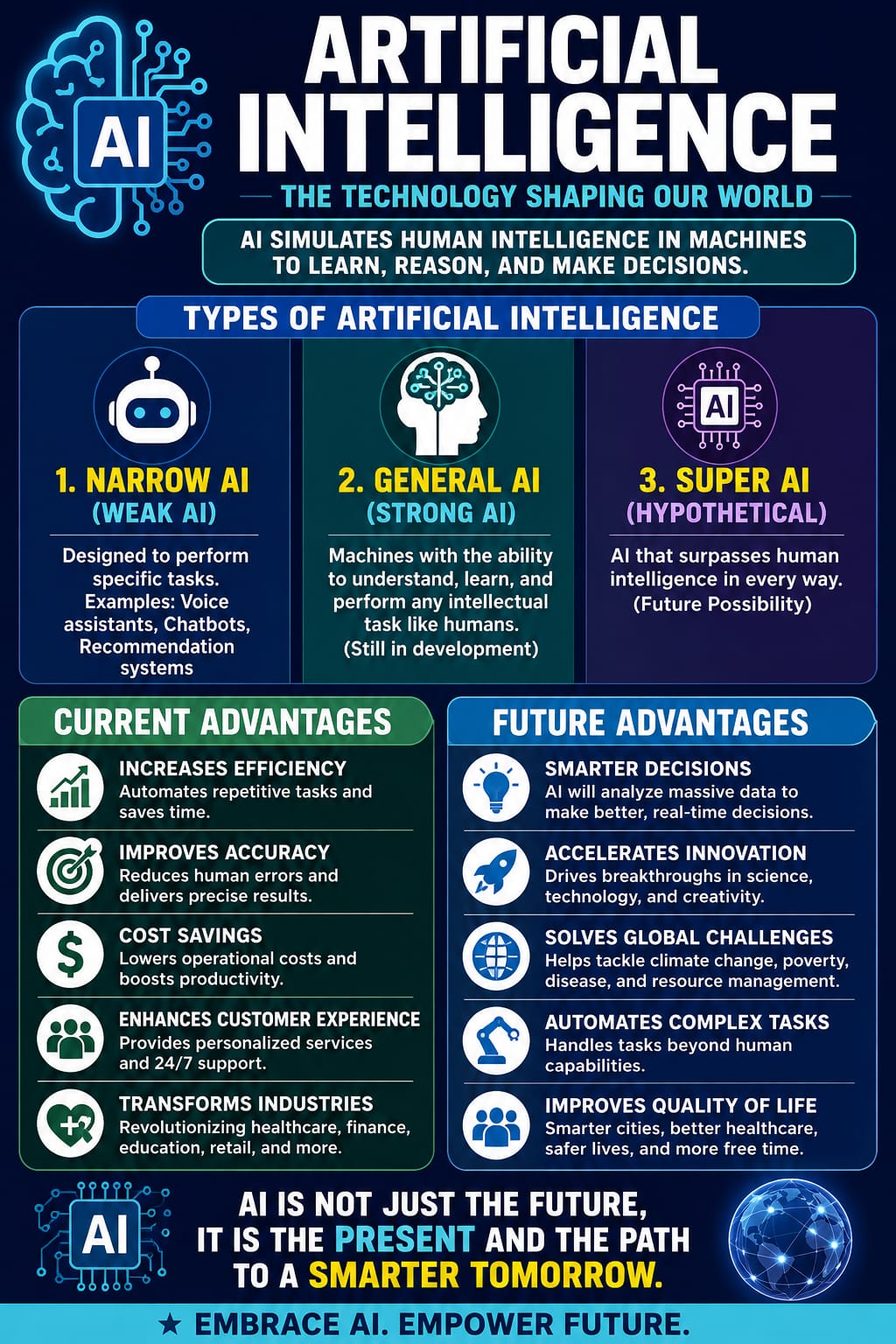
Understand what Artificial Intelligence is, explore its different categories, discover its advantages and disadvantages, and learn how AI is expected to shape the future of humanity.
Introduction
Artificial Intelligence (AI) has become one of the most influential technologies of the modern era. From healthcare and education to transportation, banking and manufacturing, AI is changing how people work, communicate and solve problems.
Unlike traditional software that follows fixed instructions, Artificial Intelligence can analyse large volumes of data, recognise patterns, learn from experience and improve its performance over time. These capabilities make AI valuable for automating repetitive work, assisting decision-making and delivering faster, more accurate results.
As AI continues to evolve, understanding its different categories, capabilities, advantages and limitations becomes increasingly important for students, professionals, businesses and society as a whole.
Quick overview: Artificial Intelligence combines computer science, mathematics and data analysis to build systems capable of performing tasks that normally require human intelligence.
What is Artificial Intelligence?
Artificial Intelligence refers to computer software and hardware designed to mimic human thinking, learning and decision-making. Instead of simply following rigid instructions, AI analyses patterns in data to adapt, improve and make informed decisions.
Modern AI systems are capable of recognising images, translating languages, analysing medical reports, recommending products, generating content and solving complex problems with remarkable speed and accuracy.
Artificial Intelligence is grouped into distinct classes based on what it can do and how it processes information. Understanding these categories helps explain the current state of AI as well as its future potential.
Did you know? Every commercially available AI system in use today belongs to the category known as Artificial Narrow Intelligence (ANI), which is designed to perform specific tasks rather than possessing general human intelligence.
Categories based on capability
Artificial Intelligence can be classified according to the level of intelligence it possesses. These capability-based categories represent the progression from today's specialised AI systems to the theoretical AI technologies of the future.
1. Artificial Narrow Intelligence (ANI)
Artificial Narrow Intelligence, also called Weak AI, is designed to perform one specific task extremely well. These systems cannot think beyond the function they were created for.
- Translating languages
- Scanning medical X-rays
- Voice assistants
- Recommendation systems
- Image recognition
Every AI application currently available belongs exclusively to this category.
2. Artificial General Intelligence (AGI)
Artificial General Intelligence represents a future stage where machines possess intellectual abilities comparable to humans. An AGI system would be capable of learning completely new subjects independently, reasoning across different fields and solving unfamiliar problems without specialised programming.
Although researchers continue exploring this area, AGI remains experimental and has not yet been achieved.
3. Artificial Superintelligence (ASI)
Artificial Superintelligence refers to a hypothetical form of AI that surpasses the collective intelligence, creativity and problem-solving abilities of all humans combined.
At present, ASI exists only as a theoretical concept discussed in scientific research and philosophical debates.
Capability summary: Today's AI is Narrow Intelligence (ANI). General Intelligence (AGI) is still under research, while Superintelligence (ASI) remains a theoretical concept.
Categories based on internal function
Artificial Intelligence can also be classified according to how it processes information and responds to its environment. These categories explain how AI systems make decisions and how advanced they are in understanding the world around them.
1. Reactive systems
Reactive systems represent the simplest form of Artificial Intelligence. These systems respond only to current inputs and do not store memories or learn from previous experiences. Every decision is made entirely from the information available at that exact moment.
- No memory of previous events
- Responds only to present situations
- Suitable for highly specific tasks
- Cannot improve through experience
Example: A chess-playing AI that evaluates only the current board position before making its next move.
2. Short-term memory systems
Short-term memory AI uses recent historical information to make better decisions. Unlike reactive systems, these models temporarily remember previous observations while performing tasks. This capability allows AI to predict changes, identify patterns and react more intelligently.
- Uses recent historical information
- Learns from short-term observations
- Improves decision making
- Widely used in autonomous vehicles
Real-world example: Self-driving cars continuously analyse nearby vehicles, road signs, traffic signals and pedestrian movement before deciding how to drive safely.
3. Cognitive-aware systems
Cognitive-aware systems represent an advanced research area in Artificial Intelligence. These systems aim to recognise and understand human emotions, intentions, beliefs, motivations and psychological states. The objective is to enable AI to communicate naturally while adapting its responses according to human behaviour and emotional context.
- Recognises human emotions
- Interprets facial expressions
- Adapts conversations intelligently
- Supports personalised human interaction
Research status: Although rapid progress is being made, fully cognitive-aware AI systems are still under active scientific research.
4. Conscious systems
Conscious systems represent the most advanced theoretical category of Artificial Intelligence. Such systems would possess genuine self-awareness, personal emotions, independent thoughts and subjective experiences. Unlike today's AI, a conscious system would understand its own existence and make decisions based on internal awareness rather than programmed instructions.
- Self-awareness
- Independent consciousness
- Personal experiences
- Human-like emotional understanding
Current status: Conscious Artificial Intelligence remains a fictional and theoretical concept. No existing AI system possesses genuine consciousness or self-awareness.
Future horizon and technical scope
Artificial Intelligence continues to evolve rapidly, and future developments may significantly transform industries, healthcare, education, transportation, manufacturing and scientific research. Researchers envision intelligent systems that collaborate with humans while solving problems beyond today's technological capabilities.
Emerging possibilities
- Self-directing industrial networks: manufacturing plants that automatically source materials, optimise production and repair equipment with minimal human intervention.
- Subatomic computing collaboration: combining Artificial Intelligence with quantum computing to model complex chemical reactions and accelerate scientific discoveries.
- Direct neural integration: connecting human thought processes directly with digital systems to improve learning, memory and communication.
- Anticipatory infrastructure management: intelligent systems capable of predicting failures in roads, bridges, power grids and public infrastructure before they occur.
- Adaptive cognitive mentorship: AI-powered education platforms that continuously adapt learning methods according to each student's strengths, weaknesses and learning style.
Looking ahead: Future Artificial Intelligence is expected to become more collaborative, predictive and personalised, supporting people across nearly every aspect of daily life while raising important ethical and societal questions.
Current advantages of Artificial Intelligence
Artificial Intelligence is already transforming nearly every industry by improving productivity, reducing repetitive work and supporting faster decision-making. Businesses, healthcare organisations, educational institutions and governments increasingly rely on AI to improve efficiency and deliver better services.
1. Workplace automation
AI automates repetitive administrative and operational tasks, allowing employees to focus on creative thinking, strategic planning and complex problem-solving.
- Automates repetitive office work
- Improves productivity
- Reduces operational costs
- Allows employees to focus on higher-value tasks
2. Instant information processing
Artificial Intelligence can analyse enormous volumes of structured and unstructured information within seconds, identifying trends, errors and unusual patterns that would otherwise take humans days or weeks to discover.
- Processes millions of records quickly
- Identifies hidden patterns
- Detects anomalies efficiently
- Supports data-driven decision making
3. Continuous service availability
Unlike humans, AI-powered virtual assistants and chatbots can provide customer support throughout the day and night without interruption.
- 24/7 customer assistance
- Faster response times
- Reduced waiting periods
- Improved customer satisfaction
4. High-precision output
Artificial Intelligence reduces human errors by consistently following established rules and analysing data with remarkable accuracy.
- Improves accuracy
- Reduces manual mistakes
- Enhances quality control
- Supports safer operations
5. Tailored consumer experiences
AI studies user behaviour and preferences to recommend products, services, educational content, entertainment and personalised experiences.
- Personalised recommendations
- Smarter online shopping
- Improved entertainment suggestions
- Better customer engagement
Key benefit: Artificial Intelligence increases efficiency, improves accuracy and enables organisations to make faster and better-informed decisions.
Future advantages of Artificial Intelligence
Researchers believe that future Artificial Intelligence systems will extend far beyond today's capabilities and become powerful partners in healthcare, education, transportation, environmental management and scientific innovation.
Proactive medical care
Future AI systems may identify diseases at extremely early stages by analysing genetic information, medical imaging and biological markers before physical symptoms become noticeable.
Self-navigating transportation
Advanced autonomous transportation systems could safely manage public transport, logistics, emergency vehicles and delivery services with minimal human intervention.
Resource optimisation
Artificial Intelligence may continuously balance electricity production, renewable energy sources, weather conditions and city-wide demand to improve energy efficiency.
Rapid scientific discovery
By simulating millions of molecular combinations, AI could significantly accelerate the discovery of new medicines, materials and environmentally friendly technologies.
Differentiated learning models
Future educational platforms may personalise lessons according to every student's learning style, strengths, pace and interests, creating highly effective learning experiences.
Future outlook: Artificial Intelligence has the potential to transform healthcare, education, transportation, environmental sustainability and scientific research while improving everyday quality of life.
Disadvantages of Artificial Intelligence
Although Artificial Intelligence offers numerous advantages, it also introduces significant social, economic, ethical and technological challenges. Responsible development and appropriate regulations are essential to maximise its benefits while reducing potential risks.
1. Workforce displacement
Automation can replace human workers in administrative, manufacturing, customer service and even creative professions faster than new employment opportunities emerge.
2. Erosion of human critical thinking
Excessive dependence on AI tools may reduce independent thinking and problem-solving abilities as people increasingly rely on automated systems for everyday decisions.
3. Spread of automated misinformation
Artificial Intelligence can rapidly generate convincing fake news, synthetic media and deepfake content that may mislead individuals and weaken public trust.
4. Severe privacy invasion
Many AI systems continuously collect and analyse personal information, raising important concerns regarding privacy, surveillance and responsible data usage.
5. Wealth and power concentration
Advanced AI infrastructure requires enormous financial investment, potentially concentrating economic advantages among a relatively small number of technology companies.
6. Devaluation of human connection
Heavy dependence on digital assistants and AI companions may reduce genuine face-to-face communication and meaningful human relationships.
7. Systemic security risks
Artificial Intelligence can also be exploited to develop automated cyberattacks, sophisticated malware and other malicious technologies capable of causing widespread disruption.
Responsible AI: The long-term success of Artificial Intelligence depends on ethical development, transparency, privacy protection, human oversight and responsible regulation.
Conclusion
Artificial Intelligence has become one of the most transformative technologies of the twenty-first century. From automating repetitive work to accelerating scientific discoveries, AI continues to reshape industries and everyday life.
While today's Artificial Narrow Intelligence already delivers remarkable benefits, researchers continue working toward more advanced systems capable of solving increasingly complex challenges. At the same time, society must carefully address concerns related to employment, privacy, security, fairness and ethical governance.
When developed and used responsibly, Artificial Intelligence has the potential to improve healthcare, education, business, scientific research, environmental sustainability and overall quality of life for people around the world.
Final thought: Artificial Intelligence should be viewed as a powerful tool that complements human intelligence. Responsible innovation, ethical development and continuous learning will determine how successfully AI benefits future generations.
Key takeaways
- Artificial Intelligence enables machines to simulate human intelligence.
- Today's AI belongs to Artificial Narrow Intelligence (ANI).
- Artificial General Intelligence (AGI) and Artificial Superintelligence (ASI) remain future concepts.
- AI can also be classified based on its internal functioning.
- AI improves productivity, healthcare, education and scientific research.
- Future AI may revolutionise transportation, medicine and personalised learning.
- Ethical AI development is essential to protect privacy, employment and public trust.
Final message: Artificial Intelligence is one of the most powerful technologies ever created. Its future depends not only on technological innovation but also on responsible human decisions, ethical governance, transparency and collaboration.
About the writer
I create well-researched, SEO-friendly and reader-focused content in the fields of healthcare, nutrition, technology, Artificial Intelligence, medical writing and educational blogging.
Areas of expertise
- Artificial Intelligence and emerging technologies
- Healthcare and medical writing
- Nutrition and healthy lifestyle
- Chronic disease awareness
- Women's health
- SEO blog writing
- Technical content writing
- Website content development
If you enjoy reading educational articles on health, technology, nutrition and AI, explore more articles through my portfolio and blog.