Future Shock and AI Realities: Understanding the World of Rapid Change
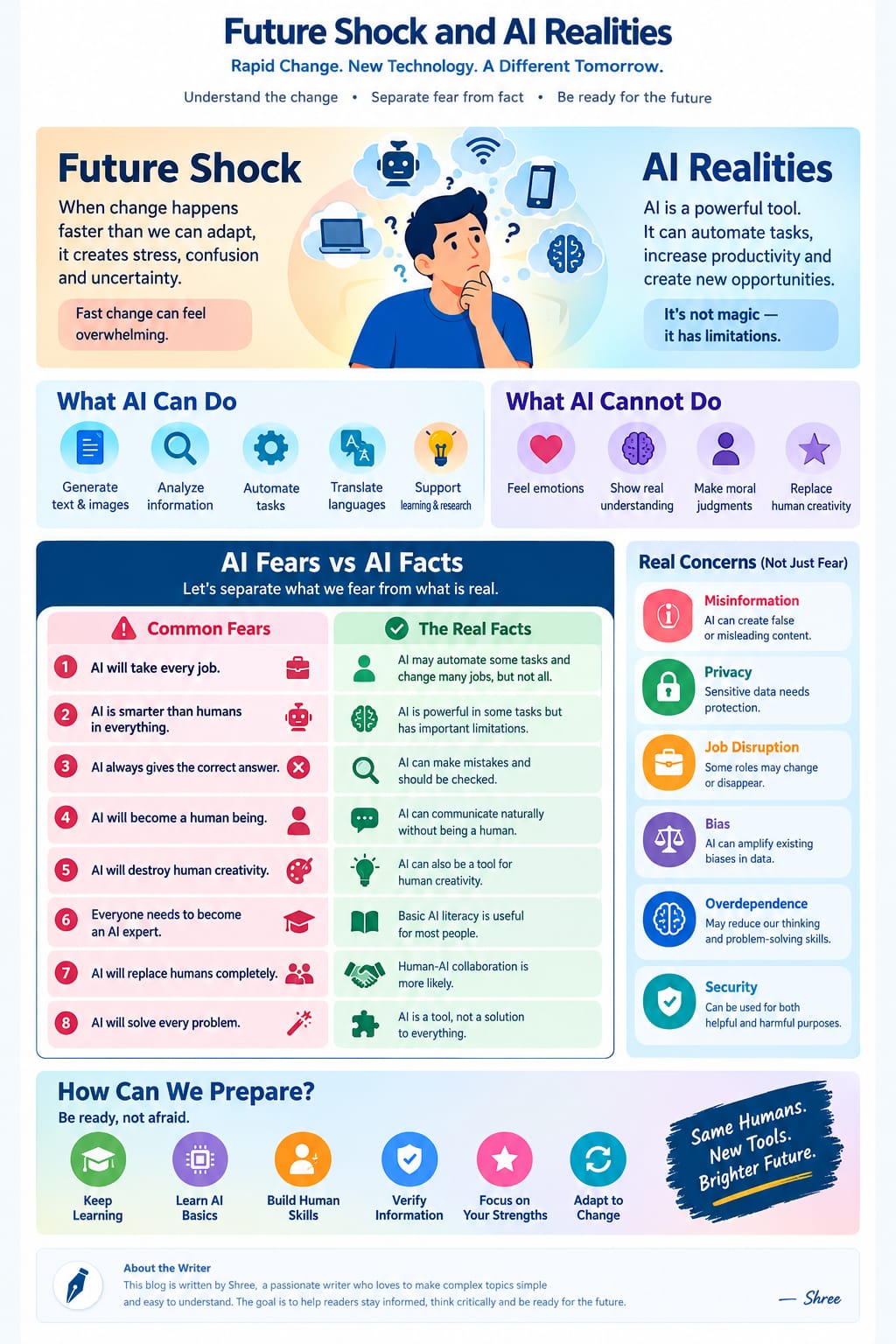
Artificial Intelligence is changing how people work, learn, create and communicate. That pace creates excitement, but also fear. This article explains the idea of Future Shock and separates common AI fears from practical AI facts.
The main idea: The future does not need to be feared simply because technology is changing quickly. Understanding AI, checking information and learning to adapt help people face change with more confidence.
What is Future Shock?
Future Shock describes the stress, confusion or difficulty people experience when society changes very quickly. The concept was popularised by the writer and futurist Alvin Toffler in his 1970 book of the same name.
The basic idea is simple: when change happens faster than people can comfortably adapt, it creates uncertainty and stress.
People living through rapid technological change may feel:
- Confused about new technologies
- Worried about losing their jobs
- Unsure which skills to learn
- Overwhelmed by constant updates
- Afraid of being left behind
Why is Future Shock becoming important today?
Smartphones, cloud computing, social media and Artificial Intelligence have each transformed parts of everyday life within a short span of years.
AI has accelerated that feeling further. Modern AI tools generate text, create images, analyse information, translate languages, summarise documents and assist with many kinds of work.
When new tools arrive before people have had time to understand the previous ones, it creates the sense that technology is permanently one step ahead.
A useful question: instead of trying to follow every new AI trend, ask "which technology can actually help me in my work or daily life?"
What are the realities of AI?
Artificial Intelligence is powerful, but it needs to be understood realistically. AI is not magic. It is technology created by humans that uses algorithms, data and computing power to perform tasks that can appear intelligent.
AI can recognise patterns, generate content, answer questions and assist with many types of work. It also has real limitations.
AI reality: AI can be extremely useful, but useful does not mean perfect. Human judgment, checking and responsible use remain essential.
AI fears versus AI facts
AI has created excitement and fear in roughly equal measure. Some fears rest on genuine concerns; others come from misunderstandings or science fiction. A balanced view means separating what people fear from what AI can realistically do.
"AI will take every job"
People worry that AI will make human workers unnecessary.
AI can automate some tasks and will change many jobs, especially repetitive or predictable work. But many roles require communication, judgment, creativity, physical interaction and accountability. The more realistic outcome is that AI changes how people work.
"AI is better than humans at everything"
AI can appear extremely intelligent because it processes large amounts of information quickly.
AI is very capable at certain tasks and weak at others. It can misunderstand context, make errors and produce incorrect information. Being powerful at one task is not the same as being better than humans at everything.
"AI always gives the correct answer"
AI responses sound confident and professional, which makes them seem trustworthy.
AI makes mistakes, and it makes them fluently. Important information should be verified against reliable sources, particularly in healthcare, finance, law and education.
"AI is becoming human"
AI can communicate in a natural, human-like way.
Natural communication does not make a system human. People should not assume AI has human experiences, emotions or understanding simply because it writes fluently.
"AI will destroy human creativity"
AI can generate text, images, music and other creative output.
AI can also work as a creative tool. Humans still supply personal experience, values, emotion, cultural understanding, purpose and direction — none of which comes from a dataset.
"Everyone must become an AI expert"
The speed of AI growth makes people feel they must learn everything about it.
Most people do not need to become AI engineers. Basic AI literacy — knowing what AI can do, what it cannot, and how to use it responsibly — is enough for the majority of jobs.
"AI will replace humans completely"
This is the strongest fear surrounding the technology.
AI is a technology used within human systems. In most situations, the realistic future is people working alongside AI, with humans providing direction, judgment and responsibility.
"AI will solve every problem"
The opposite extreme: believing AI can fix any human or social problem.
AI is a tool, not a magic solution. Its usefulness depends on data, technology, instructions, implementation and human judgment.
The comparison at a glance
| Common AI fear | More realistic fact |
|---|---|
| AI will take every job. | AI may automate some tasks and change many jobs. |
| AI is better than humans at everything. | AI is powerful at some tasks but has real limitations. |
| AI always tells the truth. | AI can make mistakes and should be checked. |
| AI is becoming human. | AI can communicate naturally without being human. |
| AI will destroy creativity. | AI can also be a tool for human creativity. |
| Everyone must become an AI expert. | Basic AI literacy is enough for most people. |
| AI will replace humans completely. | Human-AI collaboration is likely to remain the norm. |
| AI will solve every problem. | AI is a tool, not a solution to everything. |
What should we really be concerned about?
Rather than fearing every possible AI scenario, it is more useful to focus on the concerns that already matter in practice.
Misinformation
AI makes it far easier to produce large volumes of false or misleading content. People need to get better at checking sources.
Privacy
AI systems process large amounts of information. Responsible handling of personal and sensitive data is essential.
Job disruption
Some tasks and roles will change significantly as automation increases. Workers may need to learn new skills and adjust to new workflows.
Bias
AI systems can reproduce or amplify problems that exist in the data and processes used to build them.
Overdependence
If people let AI do all their thinking, they lose opportunities to develop their own reasoning and problem-solving ability.
Security
AI can be used for helpful purposes and harmful ones alike. Responsible security practice matters more as capability grows.
AI and the future of work
AI does not simply mean human work disappearing. A job is made up of many different tasks, and only some of them are suitable for automation.
Repetitive activities may increasingly be handled by AI, while people spend more time on communication, decision-making, creativity, relationships and problem-solving.
The rise of the AI-assisted worker. An AI-assisted worker treats AI as a digital helper, not a replacement:
- Writer + AI — faster brainstorming and drafting
- Designer + AI — faster idea exploration
- Researcher + AI — faster information processing
- Teacher + AI — additional learning support
- Business owner + AI — automation of repetitive tasks
In every case the human still provides direction, judgment and responsibility.
Why human skills still matter
As AI becomes more capable, human skills become more valuable rather than less.
- Critical thinkingQuestion information rather than accepting it.
- CommunicationExplain ideas clearly to people and to tools.
- CreativityBring original ideas and lived experience.
- AdaptabilityKeep learning as tools change.
Critical thinking
People need to question information and spot likely mistakes instead of accepting every AI response automatically.
Communication
Clear communication remains essential when working with people, teams and AI systems alike.
Creativity
AI generates possibilities. People supply experience, meaning, purpose and original viewpoints.
Adaptability
Tools will keep changing. The ability to learn and adjust is worth more than mastery of any single piece of software.
AI literacy and domain knowledge
Understanding what AI can do, where it fails and how to use it responsibly matters — and so does deep knowledge of your own field, because AI output still needs human direction and evaluation.
AI and education
AI can support students and teachers by explaining difficult topics, creating examples, helping with practice and offering different routes into a subject.
There is also a real risk of over-dependence. If students let AI do all the thinking, they miss the opportunity to develop their own reasoning and problem-solving skills.
The principle: use AI to learn, not to avoid learning.
How can we prepare for the AI future?
-
Keep learning
Technology will keep changing. Building a habit of learning beats trying to master one tool forever.
-
Learn the basics of AI
You don't need to be an engineer. Understanding core concepts and a few useful tools is a solid starting point.
-
Develop human skills
Communication, creativity, critical thinking and adaptability stay valuable regardless of which tools arrive next.
-
Verify information
Don't automatically believe what an AI system produces. Check anything important against reliable sources.
-
Focus on your strengths
Combine AI with your existing knowledge. Your expertise is what lets you direct AI and judge whether its output is any good.
-
Don't fear every new technology
New technology creates challenges and opportunities together. Learning to work with change reduces unnecessary fear.
Conclusion
Future Shock describes the stress and uncertainty that arise when change happens faster than people can comfortably adapt. Artificial Intelligence is one of the technologies driving that pace today.
AI can automate tasks, increase productivity and open new possibilities. It also creates real challenges around misinformation, job change, privacy, ethics and overdependence.
The future is unlikely to be simply humans versus AI. The more realistic picture is humans and AI working together, with AI handling repetitive and information-heavy tasks while people provide judgment, creativity, communication, responsibility and purpose.
Final thought: the goal is not to predict every change. The goal is to be ready for it. Learn continuously, think critically, use AI wisely, stay human.
About the writer
Thank you for reading this article on Future Shock and AI realities. I publish easy-to-understand articles covering Artificial Intelligence, prompt engineering, SEO, content writing, health, nutrition, emerging technologies and digital productivity.