What is Prompt Engineering? A Complete Beginner's Guide
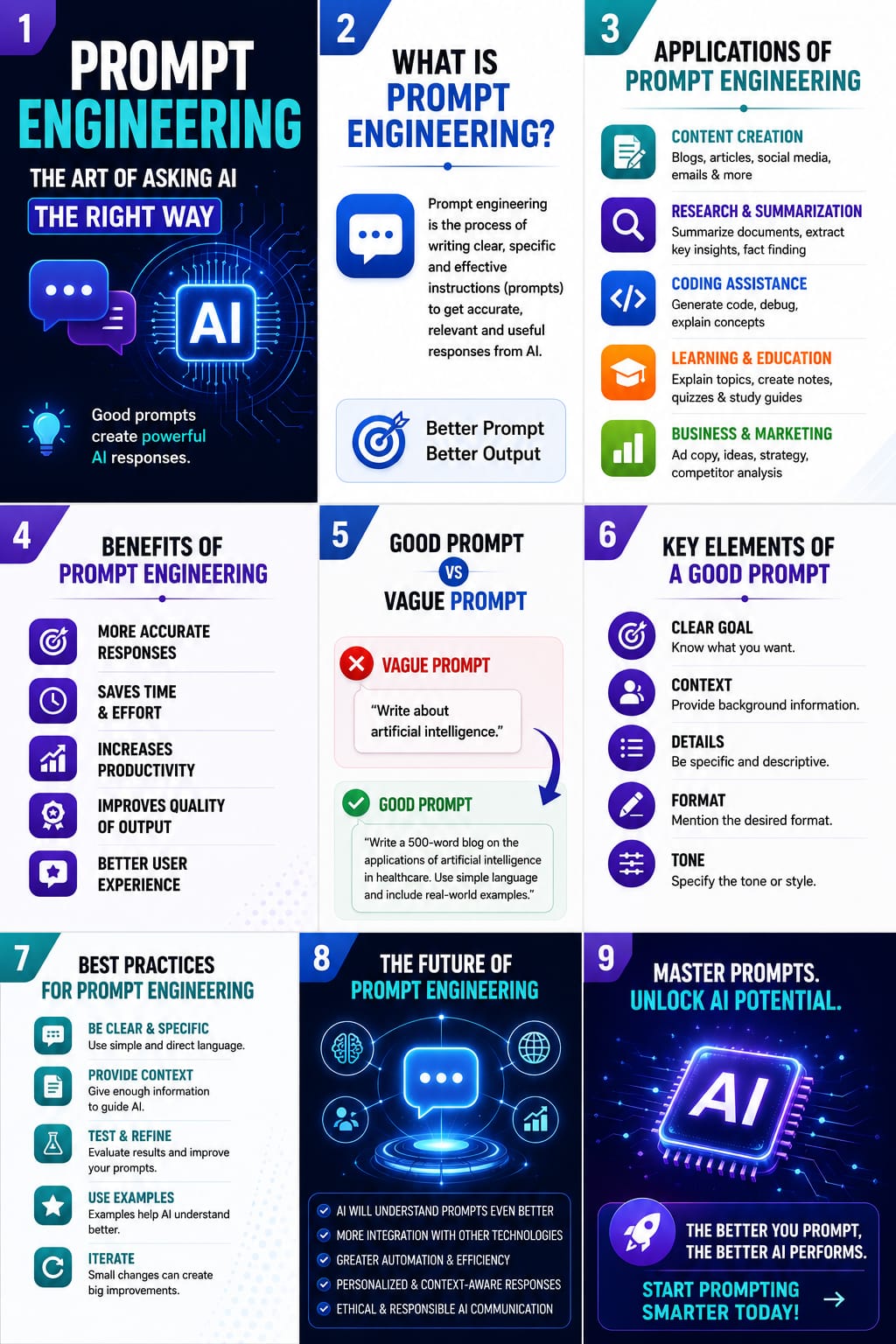
Learn how to communicate effectively with Artificial Intelligence by writing clear prompts, understanding Generative AI, exploring prompting techniques, and discovering best practices for creating accurate, high-quality AI-generated content.
Introduction
Artificial Intelligence has transformed the way people work, learn, communicate and create digital content. Modern AI tools can write articles, generate images, create videos, write software code, summarise lengthy documents, answer questions and assist with countless everyday tasks. However, the quality of the AI's response depends largely on how well the user communicates with it.
This is where prompt engineering becomes important. By learning how to write clear, structured and detailed prompts, users can significantly improve the quality, relevance and accuracy of AI-generated responses.
Quick overview: Prompt engineering is the skill of communicating effectively with Artificial Intelligence by writing clear instructions that help AI generate accurate, useful and high-quality results.
What is prompt engineering?
Prompt engineering is the process of writing clear, detailed and well-structured instructions for an AI tool to generate the desired output. It also involves refining and improving prompts until the AI produces responses that match the user's expectations.
In simple words, prompt engineering is the skill of communicating effectively with Artificial Intelligence. The better your instructions, the better the AI understands your request and generates useful, relevant and accurate responses.
Simple definition: A prompt is your instruction to AI, while prompt engineering is the process of designing that instruction to achieve the best possible result.
What is Generative AI?
Generative AI is a branch of Artificial Intelligence capable of creating entirely new content based on the instructions provided by users. Instead of simply retrieving existing information, it generates original content using advanced machine learning models trained on massive datasets.
Generative AI can create many different types of digital content, making it useful across education, business, healthcare, marketing, software development and creative industries.
Generative AI can create
- Text and articles
- Images and illustrations
- Videos
- Computer code
- Audio and music
- Presentations
Popular Generative AI tools
| AI tool | Primary use |
|---|---|
| ChatGPT | Writing, coding, brainstorming and research assistance |
| DALL·E | AI image generation |
| Claude | Long-form writing and document analysis |
| Gemini | Research, productivity and Google Workspace integration |
| Microsoft Copilot | Productivity, coding assistance and Microsoft Office integration |
These AI tools understand natural language, allowing users to interact with them using everyday English instead of programming languages.
What is a prompt?
A prompt is the instruction, question or request that you provide to an Artificial Intelligence model to perform a specific task. It tells the AI what you want it to do and guides the type of response it should generate.
A prompt can be as simple as asking a question or as detailed as providing multiple instructions regarding tone, audience, format and word count.
Examples of AI prompts
- "Explain diabetes in simple English."
- "Write a 1,000-word blog about healthy eating."
- "Generate a professional LinkedIn post."
- "Create an image of a futuristic smart city."
Key point: The AI uses your prompt to understand your request and generates a response based on the information and instructions you provide.
Why prompt engineering matters
Artificial Intelligence is powerful, but it cannot understand vague or incomplete instructions. If a prompt lacks clarity, the AI may generate responses that are too broad, inaccurate or unrelated to the user's expectations.
Writing clear, detailed prompts helps AI produce responses that are more useful, accurate and aligned with your objectives.
Benefits of good prompt engineering
- Get more accurate answers.
- Reduce the need for repeated edits.
- Create higher-quality content.
- Improve creativity and idea generation.
- Receive responses in the desired format.
- Increase productivity and save time.
Remember: Better prompts lead to better AI-generated results. Investing a little extra time in writing a clear prompt often saves significant editing time later.
How prompt engineering works
Prompt engineering is an iterative process. You begin by writing a prompt, review the AI's response, and then improve your instructions until the generated output closely matches your expectations.
Adding more context, specifying the desired format, defining the target audience or adjusting the tone often leads to much better results.
Initial prompt
This prompt may produce a general response because it lacks specific details.
Improved prompt
Because the second prompt provides clear instructions, the AI is much more likely to generate an accurate and relevant response.
Prompt engineering techniques
AI professionals use several prompting techniques to improve the quality, accuracy and consistency of AI-generated responses. Each technique is suitable for different tasks depending on the complexity of the problem.
1. Zero-shot prompting
In zero-shot prompting, you simply ask the AI to perform a task without providing any examples. The AI relies entirely on its existing knowledge to generate the response.
This method is quick and works well for straightforward writing, explanations and general questions.
2. Few-shot prompting
Few-shot prompting involves providing one or more examples before asking the AI to perform a similar task. These examples help the AI understand the desired style, format and structure.
For example, if you provide two well-written product descriptions and then ask the AI to create another one, it learns from the examples and generates a more consistent response.
Benefit: Few-shot prompting usually produces more accurate, structured and consistent results than zero-shot prompting.
3. Chain-of-thought prompting
Chain-of-thought prompting encourages the AI to solve a problem step by step instead of immediately jumping to the final answer.
This technique is especially useful for logical reasoning, mathematics, coding, planning and complex decision-making because it helps the AI organise its reasoning before generating a response.
Best used for:
- Logical reasoning
- Mathematics
- Programming
- Project planning
- Complex problem solving
Who can use prompt engineering?
Prompt engineering is valuable for almost everyone. Since AI tools are now used across many industries, learning how to write effective prompts has become an important professional skill.
Professionals who can benefit
- Content writers
- Bloggers
- Students
- Teachers
- Digital marketers
- Business owners
- Software developers
- Graphic designers
- Researchers
- Job seekers
You do not need to be an AI engineer or programmer to write effective prompts. Anyone can learn prompt engineering through regular practice and experimentation.
Best practices for writing effective prompts
Following a few simple best practices can greatly improve the quality of AI-generated responses.
Tips for better prompt writing
- Clearly describe the task you want the AI to perform.
- Provide enough background information and context.
- Mention your target audience.
- Specify the preferred writing style and tone.
- Include the desired word count or output format.
- Review the response and improve the prompt if necessary.
- Always fact-check important information before publishing.
Remember: Prompt engineering is an iterative process. Small improvements in your instructions can produce significantly better AI responses.
Advantages of prompt engineering
Prompt engineering helps users obtain more accurate, useful and high-quality responses from Artificial Intelligence systems. Well-designed prompts reduce ambiguity and allow AI models to generate content that closely matches the user's expectations.
1. Improved accuracy
A clear and well-structured prompt enables AI to produce responses that are more relevant and precise. This is particularly valuable in fields such as healthcare, education, finance, technology and research where accuracy is essential.
2. Better user experience
When users receive informative and well-organised responses, they can complete tasks more efficiently with fewer follow-up prompts. This improves the overall experience of using AI-powered applications.
3. Saves time and cost
Detailed prompts reduce the need for repeated revisions and clarification. As a result, individuals and businesses save valuable time while increasing productivity.
Major benefits of prompt engineering:
- Produces more accurate responses.
- Improves productivity.
- Reduces editing time.
- Generates higher-quality content.
- Enhances creativity and brainstorming.
- Improves communication with AI systems.
Disadvantages of prompt engineering
Although prompt engineering offers many advantages, writing effective prompts requires practice. Choosing the right level of detail can sometimes be challenging.
Finding the right level of detail
One of the biggest challenges is determining how much information should be included in a prompt.
- If the prompt is too general, the AI may generate vague or incomplete responses.
- If the prompt is too detailed, it may unnecessarily restrict the AI's creativity or produce responses that are overly specific.
Developing the ability to balance clarity with flexibility is one of the most important skills in prompt engineering.
Tip: Prompt engineering improves with practice. Experimenting with different prompt styles helps users understand which approach produces the best results for different tasks.
The future of prompt engineering
Prompt engineering is rapidly becoming one of the most valuable skills in the AI era. As Artificial Intelligence continues to evolve, writing effective prompts will become increasingly important across industries.
Better AI and natural language processing
Future AI systems will understand human language, context and user intent more accurately. This will allow prompts to generate increasingly personalised, reliable and high-quality responses.
Integration with more technologies
Prompt engineering will play an important role in many AI-powered technologies, including:
- Virtual assistants
- AI chatbots
- Voice assistants
- Smart devices
- Search engines
- Business applications
Greater automation and productivity
As prompt engineering continues to advance, AI will automate more routine tasks, allowing businesses, professionals, educators, marketers, developers and content creators to work more efficiently while producing higher-quality results.
Conclusion
Prompt engineering is one of the most valuable skills in today's AI-driven world. It enables users to communicate effectively with Artificial Intelligence systems and generate responses that are more accurate, relevant and useful. Whether you are writing blog posts, creating marketing content, generating images, developing software or conducting research, learning how to write effective prompts can significantly improve both productivity and creativity.
As Generative AI continues to evolve, prompt engineering will become an essential skill for professionals across almost every industry. Content writers, students, educators, developers, marketers, designers, researchers and business owners can all benefit from mastering this simple yet powerful technique.
Prompt engineering is far more than simply asking questions. It is the art of communicating clearly with AI by providing structured instructions, sufficient context and specific expectations. With regular practice and continuous refinement, anyone can learn to unlock the full potential of AI and consistently produce high-quality results.
Key takeaways:
- Prompt engineering improves AI-generated responses.
- Clear instructions produce more accurate and relevant results.
- Different prompting techniques are suitable for different tasks.
- Anyone can learn prompt engineering with regular practice.
- It is becoming an essential digital skill across multiple industries.
About the writer
Thank you for reading this guide on prompt engineering. I regularly publish well-researched articles covering Artificial Intelligence, prompt engineering, SEO, content writing, health, nutrition, emerging technologies and digital productivity.
Explore my latest articles and professional writing portfolio using the links below.